
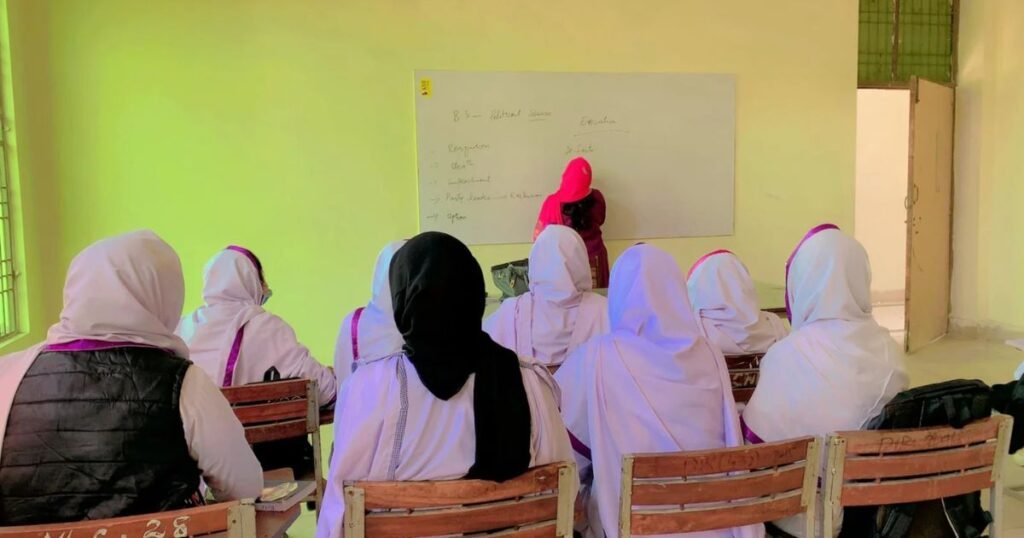
Girls looking for colleges in Nankana Sahib can start by comparing institutions listed by Punjab’s Higher Education Department. Its public-sector directory includes Govt. G.N. Degree College for Women in Nankana Sahib and women’s colleges in Bhikhi, Warburton, Sangla Hill and Shahkot. The department also lists several private girls’ colleges in the district.
However, these directories are not quality rankings. The best college for a student is the one that offers her intended course, provides a manageable daily journey, fits the family’s budget and supports a qualification suitable for her next step.
This guide presents an official-source-based shortlist and explains how to compare colleges responsibly. It distinguishes Nankana Sahib city from the wider district and avoids treating a directory entry as proof of current admissions, program availability or academic performance.
Girls’ Colleges in Nankana Sahib: An Official-Source Shortlist
Punjab’s Higher Education Department separates its Nankana Sahib college listings into public and private institutions, with female colleges identified in each directory. These listings provide a useful starting point for research, but students should confirm each institution’s current name, operational status and courses before applying.hed.punjab.gov+1
Government Colleges for Women
The department’s public degree-college directory lists the following institutions under its female category. Names below follow the directory’s wording.hed.punjab.gov
| College listed by Punjab HED | Location identified in the listing | What students should investigate |
|---|---|---|
| Govt. G.N. Degree College for Women, Nankana Sahib | Nankana Sahib | Current college name, available courses and admission guidance |
| Govt. Degree College for Women, Bhikhi | Bhikhi | Subject options and the practical daily journey |
| Govt. Degree College for Women, Warburton | Warburton | Current qualifications, intake availability and study costs |
| Govt. Degree College for Women, Sangla Hill | Sangla Hill | Available courses and suitability for the intended education pathway |
| Govt. Degree College for Women, Shahkot | Shahkot | Current academic offerings and application instructions |
This is an alphabetical or convenience-based shortlist, not a first-to-fifth ranking. A college in Shahkot or Sangla Hill may deserve consideration from a student living nearby, while a student based in Nankana Sahib city may prefer to investigate city-based options first.
The distinction matters because a district-wide search can produce results that are not equally convenient for every family.
Private Girls’ Colleges Listed in the District
The Higher Education Department’s private degree-college directory identifies the following institutions in its female category. These entries establish that the institutions appear in the directory; they do not independently confirm their current courses, fees, results or admission status.hed.punjab.gov
| Institution listed by Punjab HED | Location recorded in the directory |
|---|---|
| Al-Masoom College of Commerce & Science (Girls), Nankana Sahib | Main Road, Housing Colony, Nankana |
| Punjab College for Girls, Shahkot | Near Sahi CNG Pump, Shahkot |
| Anglo Central College Commerce (Girls), Shahkot | New College Road, Shahkot |
| Shahkot College of Commerce (Girls), Shahkot | New College Road, Shahkot |
Families considering a private institution should verify that they are contacting the correct girls’ campus. A similar college name, another branch or an older advertisement should not be used as a substitute for current campus-specific guidance.
Before paying an application or admission fee, request confirmation of the intended course and the terms that apply to that campus.
Govt. Guru Nanak Graduate College (W), Nankana Sahib
Govt. Guru Nanak Graduate College (W), Nankana Sahib is a relevant institution to investigate for students seeking a women’s college locally. Punjab’s Higher Education Department uses this graduate-college name in an official record, while its public college directory uses the older-style wording “Govt. G.N. Degree College for Women, Nankana Sahib.”hed.punjab.gov+1
The college’s website includes dedicated pages for Academic Programs, Admission Information, About Us and Downloads. These are appropriate starting points for checking its own published academic and application guidance.ggngcwnankana+3
What Prospective Students Should Check
Students considering the college should establish:
- Whether their intended intermediate or undergraduate course is currently offered.
- Which subjects or qualifications are needed to apply.
- Whether the relevant intake is open.
- How applications must be submitted.
- Which documents are requested.
- What the complete study costs will be.
- Whether any program-specific conditions apply.
The presence of an Academic Programs page should not be treated as confirmation of a particular subject until its current details have been checked.
Similarly, being eligible to apply is not the same as receiving an admission offer. Students should read the applicable admission guidance carefully and seek clarification where needed.
Use the Correct Institutional Identity
When researching a college, check its full name, location and official website. This helps prevent confusion between institutions that share “Guru Nanak” in their names or between different education providers in Nankana Sahib.
For Govt. Guru Nanak Graduate College (W), use the college’s own website when reviewing its published guidance. A notice issued by another institution should not be assumed to apply here.
What Makes a College the Right Choice for a Girl?
A useful comparison begins with the student’s learning needs rather than the institution’s popularity.
A college may be well known but unsuitable for a particular student if it does not offer her intended course. Another may be closer to home but require a subject combination that does not match her plans.
Use the following criteria to make the comparison specific.
1. The Intended Course Is Available
Start with the qualification and subjects, not the college name.
For intermediate education, establish the exact group and subject combination available. For undergraduate study, identify the precise degree title and its current structure.
Do not assume that every women’s college offers science, computer science, commerce, arts and BS programs. Likewise, the words “degree college” in a directory do not establish that every subject is available at bachelor’s level.
A practical question to ask is:
“Is this exact course available for the admission cycle in which I plan to apply?”
2. The Qualification Supports the Next Step
Students should consider what they may want to do after completing the course.
An intermediate subject choice can influence which undergraduate courses a student is eligible to enter. A degree choice can influence later study and applications for roles with specific qualification criteria.
Where a student is considering a BS pathway, HEC’s undergraduate policy provides the broader national framework, but the exact institution, program and applicable conditions still need checking.hec.gov
Avoid making a decision based only on a course title. Review the syllabus or scheme of study where available and ask what the student will actually learn.
3. The Daily Journey Is Manageable
Travel deserves the same attention as fees and subjects.
A journey that seems acceptable during one campus visit may be difficult to maintain throughout a term. Consider the route, expected travel time, available arrangements and a backup option if the usual journey becomes unavailable.
For a student living outside Nankana Sahib city, a college in her own part of the district may be worth investigating before choosing a more distant institution.
The purpose is not to select the nearest college automatically. It is to find a suitable course that the student can attend consistently.
4. The Full Cost Is Clear
Ask for current written fee details and distinguish compulsory payments from optional charges.
The study budget may include:
- Admission and tuition charges.
- Examination-related payments.
- Books and stationery.
- Printing or academic materials.
- Transport.
- Internet or device access where needed.
- Course-specific expenses.
A scholarship advertisement should not be counted as confirmed financial support until the student’s eligibility and award terms are clear.
5. Academic Expectations Are Understood
Before enrolling, ask how the course is taught and assessed.
Useful questions include:
- What attendance expectations apply?
- How are assignments and examinations organised?
- Are practical components part of the intended course?
- How can a student seek help with an academic difficulty?
- What should she do if she misses an assessment?
- Which rules affect continuation or progression?
These questions are more useful than relying on broad promotional phrases such as “excellent learning environment.”
Choosing a College After Matriculation
For girls completing matriculation, the first decision is often the intermediate pathway.
The appropriate choice should reflect academic strengths, interests and possible future eligibility. Students should not select a group only because friends have chosen it or because it is described as the most prestigious option.
Compare Subjects Before Comparing Campuses
Begin with three questions:
- Which subjects have I understood consistently at school?
- Which fields would I like to investigate further?
- What subject prerequisites apply to those future courses?
Then compare colleges offering a suitable combination.
For example, a student interested in computing should examine the entry criteria of undergraduate courses she may later consider. A student interested in language or social science study should investigate relevant intermediate options without assuming that one route is universally better.
The right choice combines interest with preparation.
Ask Teachers for Specific Guidance
A teacher can help a student interpret her results and learning habits.
Instead of asking only, “Which field should I choose?”, ask:
- Where do my results show consistent strength?
- Which topics do I find difficult, and why?
- What workload should I expect in this subject?
- What could I do before classes begin to prepare?
Specific questions produce more useful guidance and help the student participate in her own decision.
Choosing a College After Intermediate
Students who have completed intermediate should compare undergraduate options more closely.
HEC describes BS qualifications as degrees in arts or sciences, including four-year and certain five-year programs. The exact duration and structure should be checked for the qualification under consideration.hec.gov
Confirm the Exact Degree and Academic Arrangement
Before applying, establish:
- The complete qualification title.
- The institution responsible for awarding the qualification.
- The current academic or affiliation arrangement, where applicable.
- Program-specific entry criteria.
- The scheme of study.
- Any relevant recognition or professional accreditation conditions.
Do not rely on a general statement that a college is “recognised” without understanding what that means for the particular course.
Look Beyond the Degree Name
Students should consider how they will build practical ability during their studies.
Depending on the field, this may involve academic writing, presentations, spreadsheet work, research methods, programming or subject-specific practical tasks.
A sensible choice is a course the student is willing to study seriously, combined with a plan to develop relevant skills. No college or degree should be presented as guaranteeing employment.
Government or Private College: How Should Families Compare?
A fair comparison uses the same questions for both sectors.
Government status does not establish the suitability of every course, and private status does not prove better teaching or outcomes. Students should examine current, institution-specific evidence.
| Comparison point | What to establish at either type of college |
|---|---|
| Course availability | Whether the exact intended course is offered now |
| Academic arrangement | Who awards the qualification and what conditions apply |
| Cost | The complete fee schedule and likely additional expenses |
| Travel | A practical route and manageable daily journey |
| Teaching arrangements | How classes, assessments and practical work are organised |
| Student guidance | How academic questions and difficulties are handled |
| Published outcomes | Whether any results claims identify the course, year and examination body |
Treat unsupported comparisons cautiously. Statements such as “highest results” or “best faculty” need evidence before they can help a family make a decision.
An organised campus visit and current written guidance are more useful than reputation alone.
A Campus Visit Checklist for Students and Parents
A visit is most productive when the family arrives with clear questions.
Before the Visit
- Decide which course you want to discuss.
- Review the institution’s official pages.
- Prepare questions about eligibility, costs and attendance.
- Check the correct campus and location.
- Note any details that remain unclear online.
During the Visit
Ask about the intended course rather than general facilities.
If practical work forms part of the course, ask how it is arranged. If you need a particular resource or support service, confirm whether it is available to students on that program.
Also clarify how official notices are communicated and whom students should contact about academic concerns.
After the Visit
Record the answers while they are fresh. Compare colleges using the same categories rather than relying on which visit felt most impressive.
Do not make an immediate payment solely because you are told places are limited. First understand the payment, receipt, refund terms and admission conditions.
Common Mistakes When Shortlisting Girls’ Colleges
Several avoidable mistakes can make college selection less effective:
- Treating a district listing as if every college is in Nankana Sahib city.
- Assuming an old advertisement reflects the current admission cycle.
- Choosing a college before confirming the intended course.
- Comparing tuition without considering travel and other expenses.
- Assuming eligibility guarantees selection.
- Using another branch’s details for the campus under consideration.
- Accepting results or ranking claims without a clear source.
- Leaving transport arrangements unresolved until classes begin.
A directory is a starting point, not a complete assessment. Current course details and the student’s circumstances should guide the final decision.
A Simple Way to Make the Final Shortlist
Students and parents can narrow their options in five steps:
- Identify the intended stage and course: intermediate, associate degree or bachelor’s study.
- Use official listings to identify relevant institutions in the city or district.
- Confirm current course availability and entry criteria.
- Compare costs, travel and academic arrangements.
- Choose the option that the student can realistically attend and complete.
If two colleges remain suitable, give greater weight to verified course fit and practical attendance than to unsupported claims of prestige.
The student should remain part of the discussion. She will be attending classes, completing assignments and managing the academic workload.
Finding the Best Fit in Nankana Sahib
There is no evidence-based reason to declare one college the best for every girl in Nankana Sahib. Official directories identify institutions to investigate, while current program details help determine which options suit a particular student.
Govt. Guru Nanak Graduate College (W), Nankana Sahib and the other listed women’s colleges provide relevant starting points for that research. The strongest choice is one made after checking the intended course, admission conditions, full cost and daily journey—not one based only on a familiar name.
