
Education in Nankana Sahib offers students several stages to plan for: intermediate study after matriculation, undergraduate education after intermediate, and further learning or career preparation after a degree. Choosing a suitable pathway means checking the course, the institution and the practical arrangements needed to complete it.
Punjab’s Higher Education Department lists public colleges for male and female students across Nankana Sahib district, including institutions in Nankana Sahib city, Sangla Hill, Shahkot, Warburton and Bhikhi. It also maintains a separate directory of private degree colleges. These directories help students identify institutions to investigate, but they do not confirm every college’s current programs or admission availability.hed.punjab.gov+1
For students and parents, the most useful starting point is planning: identify the intended qualification, compare suitable institutions and verify current details before applying. This guide explains how to approach those decisions without relying on outdated advertisements or unsupported claims.
Understanding the Education Pathway
A student’s next step depends on the qualification she has already completed and the subjects she may want to pursue.
Intermediate education prepares students for undergraduate study. Associate and bachelor’s degrees belong to the higher education stage. HEC’s undergraduate policy applies to associate and bachelor’s degree programs offered by Pakistani universities and degree-awarding institutions.hec.gov
| Current stage | Next decision | Main point to check |
|---|---|---|
| Completing matriculation | Choose an intermediate group and subject combination | Whether the subjects support possible future degree choices |
| Completing intermediate | Compare undergraduate qualifications | Eligibility, program structure and academic interests |
| Considering an associate degree | Assess the qualification and possible progression | Whether the intended later degree accepts that pathway |
| Studying for a bachelor’s degree | Prepare for employment or further study | Relevant skills and the conditions of the next opportunity |
This sequence is a planning guide, not a guarantee of admission. Entry criteria differ between programs and institutions.
Intermediate Is a Foundation, Not a Bachelor’s Degree
Intermediate education sits between matriculation and undergraduate study. Its importance lies partly in the subject preparation it provides.
Students should therefore consider more than which group appears popular. A subject combination may affect eligibility for later courses, so future admission criteria deserve attention before the intermediate choice is finalised.
A student does not need to decide her entire career immediately. She does need enough guidance to avoid closing a pathway unintentionally.
Colleges in Nankana Sahib: City and District Are Different
A search for colleges in Nankana Sahib may return institutions throughout the district rather than only those within the city.
This distinction matters when planning attendance. A college in Sangla Hill or Shahkot may be convenient for a student living nearby but less practical for someone based elsewhere.
Use official directories to identify options, then assess the actual route and campus location. Do not assume that institutions appearing under the same district heading are equally accessible.
Public Colleges Listed by Punjab HED
The Higher Education Department’s public degree-college directory identifies the following institutions. Names below follow the directory’s wording, which may differ from names used in more recent institutional records.hed.punjab.gov
| Category in the directory | College | Location |
|---|---|---|
| Male | Govt. G.N. Degree College | Nankana Sahib |
| Male | Govt. Islamia Degree College | Sangla Hill |
| Male | Govt. Degree College | Shahkot |
| Female | Govt. G.N. Degree College for Women | Nankana Sahib |
| Female | Govt. Degree College for Women | Bhikhi |
| Female | Govt. Degree College for Women | Warburton |
| Female | Govt. Degree College for Women | Sangla Hill |
| Female | Govt. Degree College for Women | Shahkot |
These listings establish relevant institutions to research. They should not be interpreted as a ranking or as confirmation that every listed college currently offers intermediate, associate and BS programs.
Private Colleges Require the Same Careful Checks
Punjab HED also provides a private degree-college directory for Nankana Sahib. Its female category includes institutions listed in Nankana Sahib and Shahkot.hed.punjab.gov
Students considering a private college should verify the exact campus, course and current academic arrangements. A familiar college name does not establish that every branch offers the same subjects, fees or qualification.
Apply the same standard to public and private institutions: request current, course-specific details rather than relying on general promotional language.
Choosing Intermediate Subjects After Matriculation
For many students, the first major college decision is the intermediate subject group.
Common pathways include arts or humanities, science, computer science and commerce-related study. However, students must confirm the exact combinations offered by the institution they are considering.
Start With Strengths and Interests
Review school results alongside the student’s experience of learning.
Useful questions include:
- Which subjects have I understood consistently?
- Which topics hold my attention beyond examination preparation?
- Do I prefer extended reading, calculations, practical tasks or technical problem-solving?
- Which subjects would I be willing to study in greater depth?
- What advice do my teachers give, and what evidence supports it?
Marks matter, but one examination result should not replace a thoughtful discussion about preparation and motivation.
Check Future Eligibility Before Finalising Subjects
A student interested in a particular undergraduate field should read the entry criteria of relevant programs.
This is especially important where admission depends on a specific subject combination. Advice from friends or relatives can be a useful starting point, but current institutional guidance should settle the question.
Ask the prospective institution whether the planned intermediate combination meets its criteria. If the answer is unclear, seek written clarification before making a consequential choice.
Compare the Course Before the College Reputation
A well-known institution is not automatically the right option if it does not offer the intended subjects.
First identify suitable combinations. Then compare the colleges that offer them using practical factors such as cost, journey, attendance expectations and academic guidance.
This order keeps the student’s learning needs at the centre of the decision.
Understanding Associate Degree Programs
An associate degree is an undergraduate qualification completed after higher secondary education.
HEC’s undergraduate policy describes an associate degree as a two-year qualification normally structured over four regular semesters, with 60–72 credit hours. The policy also sets conditions governing its completion.hec.gov
What Students Should Investigate
Before choosing an associate degree, establish:
- The exact degree title.
- The subjects covered.
- The awarding institution.
- The college’s current academic arrangement, where applicable.
- The intended learning outcomes.
- Whether the qualification supports the student’s next step.
An associate degree should not be described simply as a shortened BS. Students need to understand it as a distinct qualification.
Progression Must Be Checked Separately
Students who intend to continue from an associate degree into a bachelor’s program should verify the receiving institution’s current policy.
Progression can involve discipline-specific conditions. For example, HEC’s published curricula illustrate different arrangements for students continuing in the same field and those entering from a related discipline. These examples should not be generalised into an automatic right of entry to every program.hec+1
Ask about eligibility, available places, semester entry and any additional coursework before relying on this route.
Understanding BS Degree Programs
A BS is a bachelor’s qualification in arts or sciences. HEC identifies four-year and certain five-year programs within its BS category, so students should check the duration of the particular qualification under consideration.hec.gov
A course title alone does not explain the full learning experience. Review the scheme of study where available and identify the balance of compulsory courses, subject courses, practical work and assessment.
Questions to Ask Before Selecting a BS
- Does my intermediate qualification meet the entry criteria?
- What will I study in the first year?
- How much reading, writing, calculation or practical work is involved?
- How is academic progress assessed?
- Who awards the degree?
- What further study or employment pathways could it support?
These questions help students choose a subject they can engage with seriously.
Recognition and Affiliation Need Precise Answers
Avoid relying on an undefined statement that a course or college is “recognised.”
Students should establish the relevant awarding institution and, where applicable, the current affiliation or professional accreditation arrangement for the exact program.
Different checks answer different questions. The identity of a college, the authority to award a degree and the status of a particular program should not be treated as interchangeable.
Women’s Education in Nankana Sahib
Women’s access to college matters both for academic opportunity and for the practical choices available later in life.
The World Bank links girls’ and women’s education with stronger earning opportunities, employment participation and better-informed decisions concerning family well-being. These are broad research findings, not guarantees of a particular outcome for every student.worldbank
For a girl in Nankana Sahib, access becomes meaningful when she can attend consistently and complete a suitable qualification.
Address Practical Barriers Early
Students and families should discuss:
- A reliable daily journey.
- The complete cost of studying.
- Time for assignments and examination preparation.
- Access to learning materials.
- A workable balance between study and household responsibilities.
- Whom to contact when an academic difficulty arises.
These arrangements deserve attention before admission, not only after a problem occurs.
Keep the Student Involved
Parents and teachers can provide valuable guidance, but the student should participate in choosing her subjects and institution.
She will be completing the coursework and managing the academic demands. Listening to her interests and concerns helps make the decision more realistic.
Education also has value beyond immediate employment. Further study, communication, informed decision-making and participation in family and community life are meaningful outcomes too.
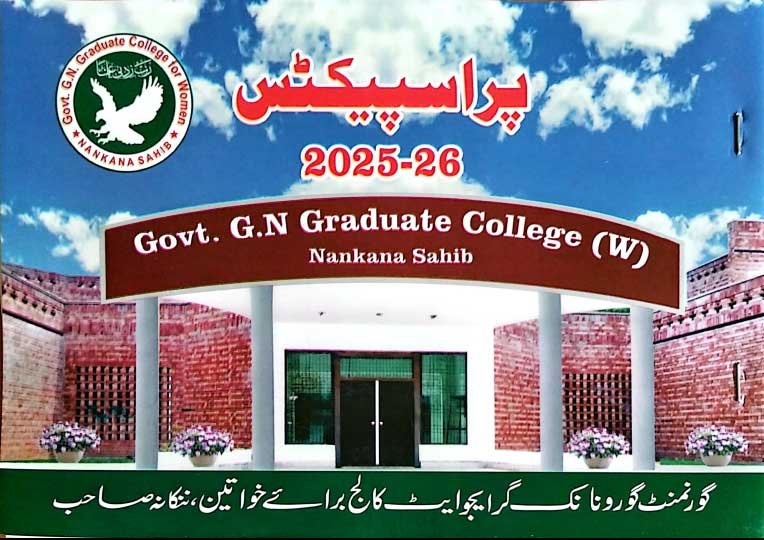
Govt. Guru Nanak Graduate College (W), Nankana Sahib
Govt. Guru Nanak Graduate College (W), Nankana Sahib is an institution students can investigate when considering local women’s education. Punjab’s Higher Education Department identifies it under that name in an official record.hed.punjab.gov
The college website includes Academic Programs, Admission Information, About Us and Downloads pages. These provide relevant starting points for reviewing the institution’s own published guidance.ggngcwnankana+3
Use Program and Admission Pages for Different Questions
The Academic Programs page is the appropriate starting point for investigating courses. The Admission Information page should be reviewed for application guidance and applicable conditions.
Students should confirm current availability for their intended intake. An older notice or an indexed page title should not be treated as proof that a particular course is accepting applications now.
Where details remain unclear, seek clarification before submitting documents, paying a fee or arranging travel.
A Step-by-Step College Admissions Plan
A clear application process reduces avoidable uncertainty.
Step 1: Identify the Exact Course
Write down the intended qualification and subject combination.
“Admission to college” is too broad to guide research. The exact course determines which criteria and documents matter.
Step 2: Read Current Official Guidance
Check the institution’s current notice or admission page for:
- Application opening and closing dates.
- Eligibility.
- Submission method.
- Requested documents.
- Selection procedure.
- Instructions following an offer.
Do not assume that last year’s schedule or process still applies.
Step 3: Prepare Documents Carefully
Use the institution’s current checklist rather than a generic list.
Check names, dates and other details for consistency across documents. If something is missing or differs between records, ask how it should be addressed before the deadline.
Step 4: Keep an Application Record
Retain copies of submitted forms, receipts and relevant correspondence. Record any application reference number provided.
These records can help resolve questions about submission or payment.
Step 5: Follow Official Updates
Submitting an application is not the final step. Check subsequent notices and respond within the applicable timeframe.
Eligibility, selection and confirmation of admission are separate stages. Understand what action is required at each one.
Planning Fees, Travel and Study Time
A manageable education plan accounts for more than tuition.
Build a Complete Budget
Ask for current fee details and identify likely additional expenses, including books, stationery, travel, printing and course-specific materials.
Where financial assistance is advertised, confirm the eligibility conditions and what the award covers. Do not count unconfirmed support as available funding.
Test the Daily Journey
Review the route, expected travel time and arrangements for returning home.
If possible, assess the journey at the time the student would normally travel. Consider a backup plan if the usual arrangement becomes unavailable.
Protect Regular Learning Time
College study includes work outside the classroom.
A weekly plan should allow time for reading, assignments, revision and rest. Regular study is more manageable than leaving all preparation until examinations are close.
Student Guidance and Career Preparation
Career preparation should develop alongside academic study rather than begin only after graduation.
Build Relevant Skills
Depending on the course, useful activities may include:
- Writing clear documents and professional emails.
- Preparing presentations.
- Using spreadsheets.
- Practising research and source evaluation.
- Developing subject-specific technical skills.
- Explaining academic projects confidently.
Choose skills that complement the qualification rather than collecting unrelated certificates.
Keep Evidence of Your Work
A portfolio may include a revised essay, presentation, research summary, coding project or carefully explained analysis.
The work should be the student’s own. A portfolio is useful when it demonstrates ability and progress, not when it simply gathers files.
Investigate the Next Step Early
Read actual job advertisements or further-study criteria to understand what may be expected.
Some pathways require additional qualifications, tests, experience or professional registration. A degree can provide a foundation, but it should never be presented as a guaranteed job.
Making an Informed Education Choice
Education in Nankana Sahib is best approached as a sequence of informed decisions: choose suitable subjects, identify relevant institutions, verify current academic arrangements and plan how to attend consistently.
Official college directories provide a starting point. Institutional program and admission pages answer more specific questions. Teachers, parents and students then need to connect that evidence with the student’s abilities, interests and circumstances.
A successful choice is not simply an admission offer. It is a pathway the student can realistically complete and use as a foundation for further learning and future opportunities.
