
When a girl finishes matric or intermediate, her family faces a big decision: government college or private college? Both can offer good education, and the right choice depends on the student, the institution and the family’s situation. This guide compares government women’s colleges and private colleges on fees, safety and quality, so you can decide with facts instead of rumors.
Please note: colleges differ widely, and no category is automatically better than the other. Use this guide as a framework, and always verify details with each college directly.
What Is a Government Women’s College?
A government women’s college is a public-sector institution that educates only female students. It is run under the education department, follows government policies for admission and fees, and offers programs recognized by the relevant board or university. Teaching posts are generally filled through public recruitment processes, and admissions are mostly based on merit.
Quick Comparison
Here is a general picture. Individual colleges may differ.
- Fees: government colleges usually charge much lower fees than private colleges.
- Environment: women-only campuses offer a focused, comfortable setting, while private colleges may be women-only or co-educational.
- Faculty: government colleges recruit through public selection, while private colleges set their own hiring standards, which vary widely.
- Admission: government colleges are mostly merit-based, while private colleges may have more flexible admission, sometimes with higher costs.
- Facilities: private colleges sometimes offer newer buildings and extras, while government colleges often have strong core facilities, though this varies by college.
- Recognition: both need to be properly affiliated, so always check.
Comparison 1: Fees and Cost
Cost is one of the biggest reasons families choose government colleges.
- Government colleges: admission and tuition fees are set at public-sector rates and are generally affordable. Some students may also be eligible for concessions, scholarships or financial aid under government schemes, depending on the rules of the year.
- Private colleges: fees are usually higher and can increase from year to year. Extra charges such as transport, activities or uniforms can add up.
What to do: ask each college for the full yearly cost in writing, including admission, tuition, exam, and other charges. Add the cost of books, transport and any other regular spending to get a true total.
Over a two-year Intermediate or four-year BS program, the savings from a government college can be significant, and may free family resources for books, entry test preparation or later studies.
Comparison 2: Safety and Environment
Safety is a top concern for parents, and rightly so.
- Women-only campus: a girls-only environment is a major reason many parents prefer government women’s colleges. It allows students to focus on studies, speak freely in class and take part in activities with confidence.
- Discipline and supervision: government colleges follow official codes of conduct and staff supervision. Standards still vary, so visit and see for yourself.
- Private colleges: some are excellent and some are not. Safety, supervision and campus culture depend entirely on the institution.
What to check on any campus:
- A secure boundary wall and gate
- Staff present at entry and exit times
- A clear process for parent communication and attendance
- Clean, safe washrooms and drinking water
- A safe and reliable route to the college
A short visit and a few direct questions will tell you more than any advertisement.
Comparison 3: Quality of Education
Quality depends on teachers, facilities, discipline and student effort, not just whether the college is government or private.
- Teachers: government colleges generally recruit through public selection, which sets a baseline of qualifications. In private colleges, teacher quality ranges widely.
- Curriculum: both must follow the board or university syllabus for their programs. Private institutions sometimes add extra classes or test preparation, at extra cost.
- Class size: government colleges may have larger classes, especially in popular programs, so active student participation matters. Private colleges may advertise smaller classes, which you should verify.
- Laboratories: science and computer practicals matter for FSc and ICS. Ask to see labs in any college you consider.
- Results: ask for actual results and what graduates go on to do, not general promises.
Comparison 4: Recognition and Future Opportunities
What matters for your future is whether the degree is recognized and whether the college prepares you for the next step.
- Affiliation: check the board for Intermediate programs and the affiliating university for BS programs, for any type of college.
- Pathways: a college that offers both Intermediate and BS lets a student continue in the same place without searching for a new institution.
- Support: guidance for group selection, entry tests, scholarships and careers is more important than a fancy building.
Why Many Families Choose Government Women’s Colleges
- Affordability: quality education at government rates.
- Women-only campus: a comfortable, focused environment for girls.
- Recognized qualifications: programs aligned with official standards.
- Merit-based admission: seats allocated through published criteria.
- Local access: studying in your own city or district saves on transport, hostel and relocation costs.
- Room to grow: many government women’s colleges now offer BS programs alongside Intermediate.
When a Private College May Be the Better Fit
A fair guide should also say when another option could suit a student better. A private college may make sense if:
- The group or program you want is not offered in your nearby government colleges
- You did not get a seat on merit and want a quicker option
- A particular private institution offers facilities or support that match your goals, and your family can afford the full cost
In every case, verify affiliation, fees and results first.
How to Decide: A Simple Process
- List your goals. What do you want to study and become?
- Shortlist 2 to 3 colleges. Include both government and private options if relevant.
- Visit them. See the campus, meet staff and ask questions.
- Compare using the same questions. Fees, safety, teachers, labs, results and support.
- Talk to current students and parents. Real experiences are valuable.
- Decide as a family. Include your daughter in the decision.
- Keep a backup. Apply to more than one place.
Frequently Asked Questions
Are government women’s colleges safe?
Many parents find them a comfortable and secure option because they are women-only and follow official rules. Safety still depends on each campus, so visit and check the basics yourself.
Is the education quality in government colleges good?
It can be very good, and many successful professionals studied in government colleges. Quality depends on the particular college, its teachers, facilities and the student’s own effort.
Are government college fees really lower?
Generally yes. Government colleges follow public-sector fee schedules, which are usually much lower than private fees. Ask the college office for the current full fee schedule.
Can my daughter do BS after Intermediate in the same government college?
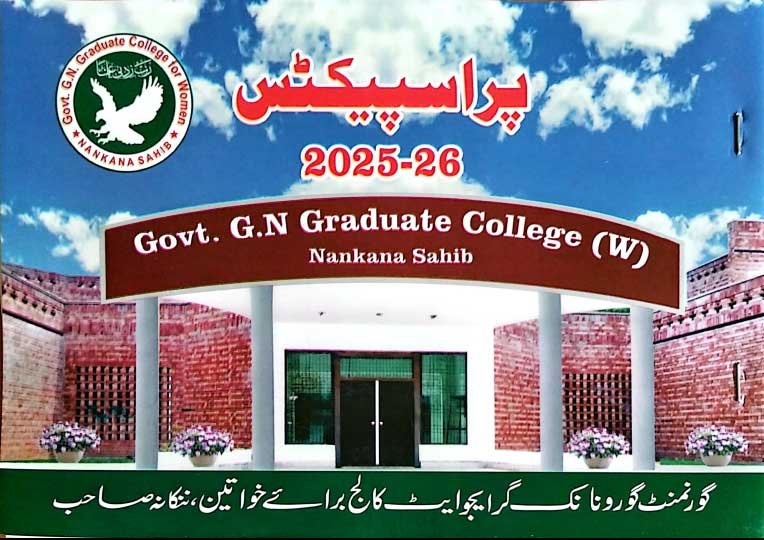
If the college offers BS programs, yes, subject to the eligibility and merit criteria. At Govt Guru Nanak Graduate College (W), Nankana Sahib, we offer BS English Literature, BS Islamic Studies and BS Political Science, affiliated with GCUF.
Is a degree from a government college valued by employers?
Employers and universities look at the recognized qualification, your marks, your skills and your performance. A properly affiliated degree from a government college is recognized in the same way as other degrees from the same board or university.
Join Govt Guru Nanak Graduate College (W), Nankana Sahib
Established in 1964 and operating as an independent women’s college since 1992, our college offers FSc Pre-Medical, FSc Pre-Engineering, ICS, FA (IT) and FA, plus BS English Literature, BS Islamic Studies and BS Political Science, in a women-only campus with government college fees. We invite you to visit, meet our teachers and compare us with other options. For admission details, read our Admission Information page or call +92 306 4211920 / 0569201067.
