
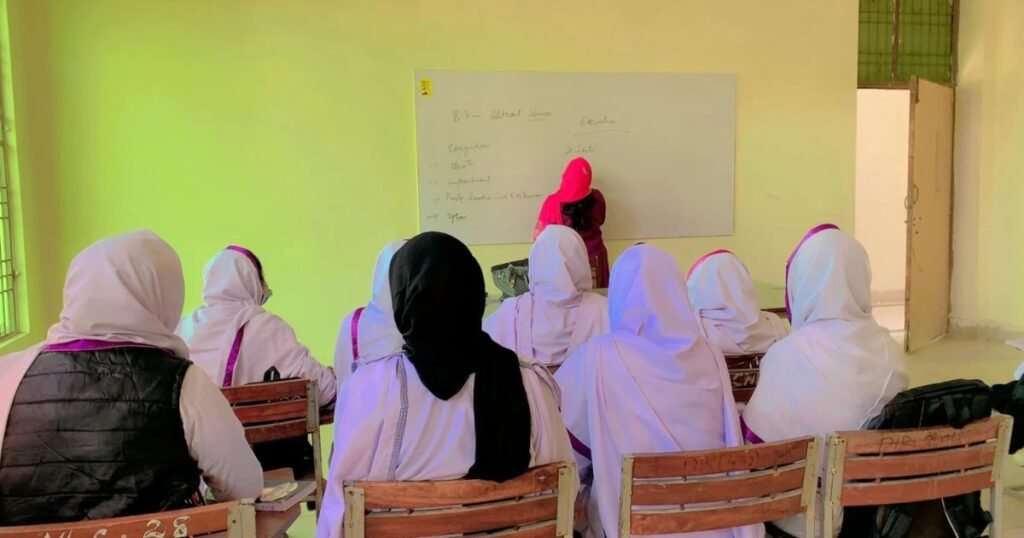
Higher education for women in Nankana Sahib matters because it can expand career choices, strengthen independent decision-making and help students develop the knowledge needed for further study, employment and everyday life. Its value goes beyond earning a degree: it gives women more ways to participate in their families, workplaces and communities.
For students and parents, the practical question is how to make that opportunity achievable. A suitable subject combination, a manageable journey to college, a realistic budget and a clear plan after intermediate education can help turn an intention to study into a sustainable academic pathway.
The benefits are supported by wider research. The World Bank connects girls’ and women’s education with stronger earning opportunities, greater participation in formal employment and better-informed decisions about health and family well-being. These are broad findings, not promises of a particular outcome for every graduate in Nankana Sahib.
What Higher Education Means—and Where Intermediate Fits
Higher education generally refers to study beyond higher secondary education, including undergraduate degree programs. Intermediate education is the stage that prepares students for those programs; it should not be confused with a bachelor’s degree.
In Pakistan, the Higher Education Commission’s undergraduate framework covers associate and bachelor’s degree programs. HEC describes BS qualifications as degrees in arts or sciences, including four-year and certain five-year programs. Students should check the duration and structure of the particular qualification they intend to pursue.hec+1
For a student planning her education after matriculation, the pathway usually involves three separate decisions:
| Education stage | Main decision | Why it matters |
|---|---|---|
| After matriculation | Select an appropriate intermediate group and subject combination | Subjects can influence eligibility for later study |
| After intermediate | Compare available undergraduate programs and their entry criteria | Degree choices should match academic preparation and interests |
| During a degree | Develop practical skills and plan the next step | Graduation is more useful when supported by evidence of ability and career preparation |
These decisions are connected, but they do not need to be settled all at once. A matric student needs an informed subject choice, while an intermediate student needs a clearer understanding of degree options.
Intermediate Choices Deserve Early Attention
Students should avoid choosing subjects only because friends have selected them or because one group is considered more prestigious.
Common intermediate pathways in Pakistan include arts, science, computer science and commerce-related study. Their availability and subject combinations vary between institutions. Before applying, students should confirm what a college currently offers and check the entry criteria of degree programs they may later consider.
A useful starting point is to ask:
- Which subjects do I understand and enjoy?
- Where do my school results show consistent strength?
- Which future courses require particular subjects?
- Can I manage the expected workload?
- Who can explain the options without pressuring me into one field?
This approach keeps future choices open while recognising the student’s actual abilities.
Why Access to College Matters Locally
For families considering colleges in Nankana Sahib, access involves more than finding an institution on a map. It also means understanding whether a student can attend regularly, afford the full cost of studying and continue through examinations and later semesters.
A local option may make education more manageable when it reduces the need for relocation or a lengthy daily journey. However, proximity alone does not establish whether a college or program is suitable. Students still need to assess the subjects available, the qualification offered and the practical conditions of attendance.
The Role of Government Colleges for Women
Government colleges are part of the local education landscape that students and parents should consider when comparing study options.
Punjab’s Higher Education Department identifies Govt. Guru Nanak Graduate College (W), Nankana Sahib in its official records. Its college directory also lists women’s colleges in other parts of Nankana Sahib district, demonstrating the importance of distinguishing the city from the wider district when planning a journey to college.hed.punjab+1
A women’s college may suit a family’s preferences, but the decision should remain focused on the student’s education. The important questions concern the course, attendance arrangements, academic expectations and ability to complete the qualification.
Government status should not be treated as evidence of a particular fee, scholarship, transport service or admission guarantee. Each of those details needs separate confirmation.
How Higher Education Can Broaden Women’s Opportunities
More Informed Career Choices
A degree can provide the academic foundation needed to pursue further qualifications or apply for roles that specify graduate-level education. It can also help students discover interests they did not fully understand at school.
The World Bank identifies stronger employment participation and earning opportunities among the wider benefits associated with educating women. However, a qualification does not guarantee a job, and international findings should not be presented as a forecast for an individual student.
Students should therefore connect their studies with practical preparation:
- Read actual job advertisements to understand qualification expectations.
- Ask teachers how a subject connects with further study.
- Practise written communication and presentations.
- Develop relevant digital skills.
- Keep examples of academic work that demonstrate understanding.
The goal is not simply to finish a degree. It is to become better prepared for the opportunities that the degree may help make accessible.
Stronger Communication and Reasoning
College work can give students structured opportunities to explain ideas, compare evidence, write arguments and respond to questions.
A literature assignment may require interpretation. A social science project may require evaluating competing explanations. A science task may require observation and careful analysis. Although the activities differ, each can encourage students to move beyond memorising an answer.
Students can strengthen these abilities by taking an active role in their studies: asking questions, requesting feedback and revising work rather than treating submission as the end of learning.
Greater Confidence in Making Decisions
Confidence should not mean knowing every answer. It means being able to ask an informed question, recognise uncertainty and seek reliable guidance.
For a college student, that might involve:
- Explaining why a particular subject interests her.
- Discussing an academic difficulty with a teacher.
- Comparing two degree pathways.
- Checking whether an opportunity is genuine.
- Making a realistic plan for study and personal responsibilities.
World Bank research on gender and education links greater educational attainment with women’s ability to make and implement decisions. That relationship is important, but students should still receive support rather than be expected to solve every challenge alone.
The Benefits Extend Beyond Employment
Women’s education should not be valued only by immediate earnings. A woman may pursue employment, further study, entrepreneurship, family responsibilities or several of these at different stages of life. Education can remain useful across those choices.
Better-Informed Family Decisions
Research associates women’s education with better-informed decisions about nutrition and healthcare, alongside benefits for children’s well-being. These are population-level relationships, not a claim that education replaces professional medical advice or determines every family’s circumstances.
In practical terms, students can use the habits developed through study to ask questions, compare explanations and identify when specialist help is needed.
Support for the Next Generation
An educated woman can contribute to a younger family member’s learning by encouraging reading, discussing subject choices and helping them approach schoolwork thoughtfully.
World Bank research also describes intergenerational benefits associated with female education, including links with children’s educational opportunities.
However, women’s education has value in its own right. A student does not need to justify her degree only through what she may later do for others.
Participation in Community Life
Higher education can also prepare students to contribute ideas, organise activities and communicate about issues that affect their communities.
Such participation does not require a public position. It may begin with helping organise a learning activity, explaining a process clearly or contributing responsibly to a group discussion. These are useful forms of participation whether a graduate enters paid employment immediately or follows another pathway.
Choosing a Degree With Purpose
Students comparing BS degree programs should look beyond the course name. The syllabus, assessment methods and entry criteria provide a better picture of what studying the subject will involve.
HEC’s undergraduate policy establishes minimum standards for undergraduate education in Pakistan. Nevertheless, students must check the actual program and institution rather than assuming that every degree follows an identical structure.hec
Use Four Questions to Compare Subjects
- Interest: Would I still want to study this subject when the work becomes demanding?
- Preparation: Do I have the background knowledge or subject combination needed?
- Learning style: Am I comfortable with the reading, writing, calculations, practical work or research involved?
- Direction: What further study or employment pathways could this qualification support?
These questions encourage a more useful discussion than asking which degree is universally “best.”
Connect Subjects With Possible Pathways
The following examples illustrate how students can investigate a field. They are not a list of programs currently offered by Govt. Guru Nanak Graduate College (W), Nankana Sahib.
| Broad subject area | Abilities students can develop | Directions worth investigating |
|---|---|---|
| Languages and literature | Interpretation, writing and communication | Education, publishing, editing and communication-related work |
| Social sciences | Research, argument and understanding institutions | Further study, research support, public-sector and community-related work |
| Computing | Technical problem-solving and digital project work | Software, IT support and other technology-related roles |
| Business and commerce | Organisational, financial and analytical skills | Accounting-related study, administration and business activity |
| Natural sciences | Scientific reasoning and analytical work | Further scientific study and roles with relevant technical criteria |
Each direction needs additional checking. A teaching post may require a professional qualification. A technical role may demand particular software skills. A public-sector vacancy may specify a degree, test or other eligibility conditions.
The degree is a foundation, not a substitute for checking the next step.
Turning Academic Study Into Practical Readiness
Students do not need to wait until their final semester to begin preparing for life after college.
Build Useful Skills Gradually
A manageable development plan might include:
- Learning to prepare clear documents and presentations.
- Practising spreadsheet tasks relevant to study.
- Writing professional emails.
- Organising files and assignments systematically.
- Understanding how to find and acknowledge reliable sources.
- Practising interviews and explaining academic projects.
Choose skills that complement the course rather than collecting unrelated certificates.
Keep Evidence of Learning
A simple portfolio can help a student see her progress. Depending on the subject, it might contain a revised essay, research summary, presentation, coding project or carefully explained analysis.
The purpose is to demonstrate the student’s own work. Do not include confidential material, copy someone else’s assignment or present a group project as an individual achievement.
Approach Online Work Realistically
Freelancing and remote work may interest students, but they should not be presented as effortless alternatives to education.
Before committing time or money to an opportunity, examine the task, payment arrangement and identity of the organisation involved. Avoid treating claims of guaranteed income as career guidance.
A stronger approach is to first build a demonstrable skill, practise it responsibly and learn what genuine clients or employers expect.
How Parents Can Help Women Continue Their Education
Family support becomes most useful when it addresses practical obstacles rather than offering encouragement alone.
Plan the Full Study Budget
Ask for the official fee details, then consider other likely expenses:
- Travel.
- Books and stationery.
- Printing and academic materials.
- Internet or device access where needed.
- Examination-related expenses.
- Any program-specific costs.
A complete estimate is more helpful than comparing tuition alone. Do not assume that a scholarship or fee concession is available until its terms have been confirmed.
Review the Journey Before Admission
For a student travelling within Nankana Sahib city or from elsewhere in the district, the daily journey deserves careful planning.
Discuss the route, expected travel time, available arrangements and a backup plan if the usual option is unavailable. Where appropriate, check the journey at the time the student would normally travel.
Transport planning should support attendance, not remain an unresolved issue until classes begin.
Protect Time for Learning
Students need time outside the classroom to read, complete assignments and prepare for examinations.
Families can help by agreeing on a workable balance between study and household responsibilities. A timetable should allow regular learning time rather than relying only on intensive revision immediately before exams.
Listening matters too. If a student is struggling, first identify whether the difficulty concerns the subject, workload, travel or another issue. The response should address the actual problem.
Where Govt. Guru Nanak Graduate College (W) Fits
Govt. Guru Nanak Graduate College (W), Nankana Sahib is one institution students can investigate when considering local women’s education. Its official website includes pages for Academic Programs, Admission Information, About Us and Downloads.ggngcwnankana+4
Those pages provide relevant starting points for checking the college’s own published material. Students should review the current program details and admission notices rather than relying on an older advertisement or an unofficial social media post.
When reviewing the Academic Programs page, identify the exact course under consideration. When reviewing Admission Information, distinguish eligibility from selection: being eligible to apply should not be assumed to guarantee admission.
If a detail remains unclear, seek clarification before making a payment, arranging travel or ruling out another option. Current fees, intake availability, deadlines and program-specific criteria should always be confirmed for the relevant admission cycle.
A Practical Plan for Students and Families
A clear sequence can make education planning easier:
- Identify the student’s current stage: matriculation, intermediate or undergraduate study.
- Review strengths and interests using both results and teacher feedback.
- Shortlist suitable subjects before comparing institutions.
- Check current official program and admission details.
- Compare the full cost and daily journey.
- Discuss how study time will fit with other responsibilities.
- Prepare documents according to the institution’s current instructions.
- Set an initial learning goal, such as improving academic writing or building a relevant digital skill.
This process keeps the student’s learning at the centre of the decision. It also gives parents and teachers specific ways to help without making unsupported promises about jobs or admissions.
Making Education an Achievable Long-Term Choice
Higher education for women in Nankana Sahib is most valuable when access is matched with thoughtful subject selection, consistent attendance and practical preparation for the next stage.
Students should be encouraged to pursue qualifications that fit their abilities and ambitions. Families can help by planning costs, travel and study time. Colleges can support informed decisions by keeping academic and admission guidance clear.
The aim is not simply to enrol. It is to help a student continue learning, complete a suitable qualification and leave college better prepared to make her own choices.
